
Exploring Cumberland Island: A Day at the Edge of Another World
Updated: Apr 30
Some places announce themselves with skyline and noise. Cumberland Island begins with a whispering tunnel of live oaks that makes you feel like you’ve stepped off the map.

The Only Way In
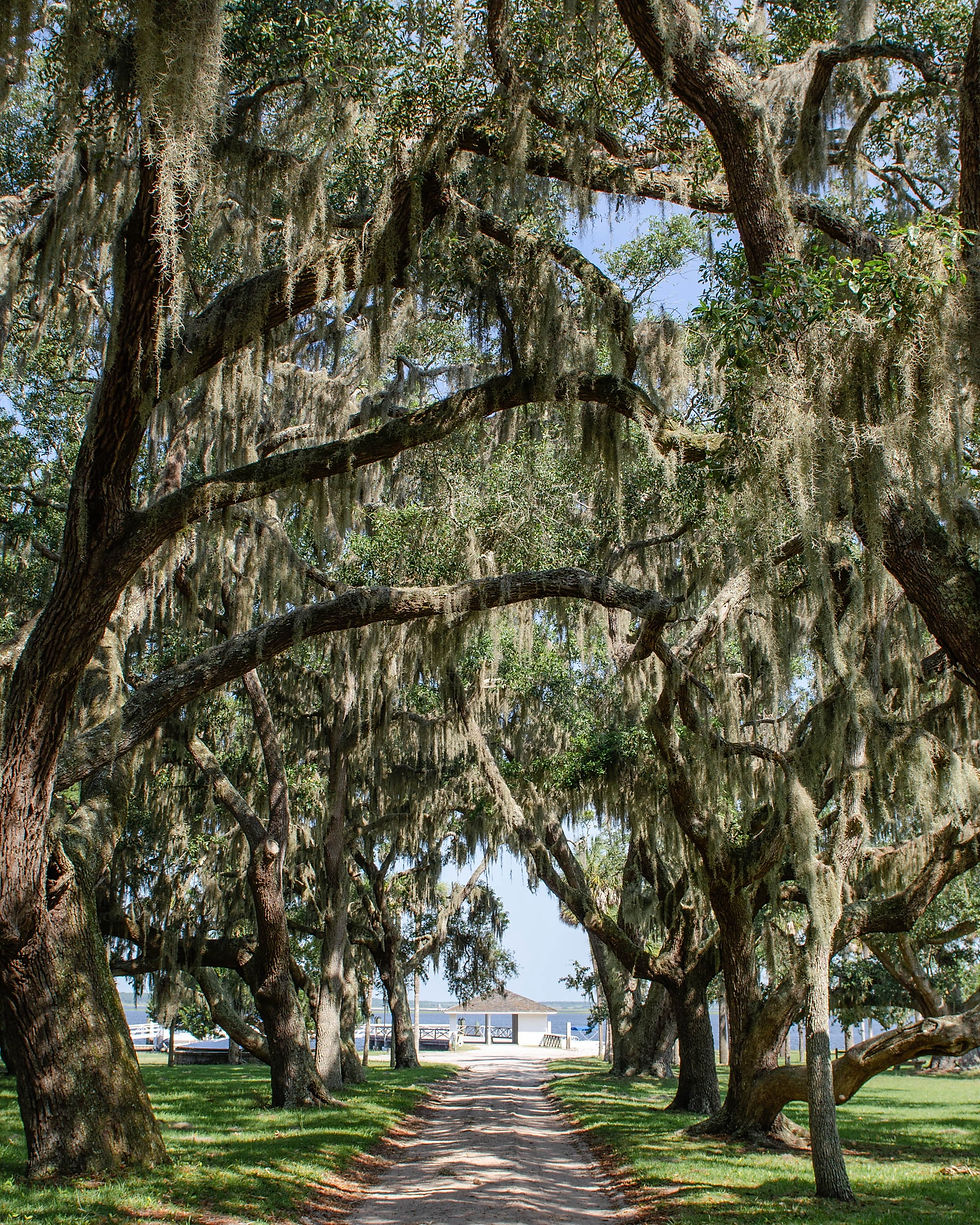
A couple of hours before I ever meet that shaded road and wander under its immaculate branches, I catch the early morning ferry from St. Mary’s, the only way to the island, sharing the deck with just a handful of the 300 daily permitted visitors. As the boat noses up to the dock, I catch my first full glimpse of those moss‑draped branches reaching out from the shore, already hinting at the green corridor ahead of me.

The Tunnel of Oaks
Stepping off the ferry, the first thing that greets me is that tunnel of live oaks, their branches reaching across the sandy road like they’re stitching a doorway into another world.
The air is warm and still under all that Spanish moss, muffling the sounds from the dock until it feels like I’ve slipped out of ordinary time and into a world that runs on its own unspoken rules.
Sunlight filters through the leaves in broken patches, tracing patterns on the road ahead and inviting me to follow this green corridor and see what waits at the other end.
The Island to Myself
By the time I finish roaming this shaded entrance, squeezing every frame I can from that tunnel of trees, the others from my ferry have melted into the distance, leaving me to make the quiet half‑mile walk toward Dungeness on my own.

Ready to begin my exploration, I hoist my backpack of day‑trip supplies a little higher on my shoulder and follow the sandy road with only the sights and sounds of the island around me. As I walk the twisting path, morning light glitters through the wind‑shaped branches, catching on the tropical vegetation at my feet.
Where the Road Bends South
After a while, the road bends toward the island’s southern tip, and my thoughts start to drift ahead to the ruins I’ve come to see. The anticipation of the sight of the old Carnegie mansion carries me back to the Gilded Age. It may, as it sits now, be just a skeleton of what it once was, but even in ruin it still draws visitor after visitor across the water to see it for themselves. And here it has drawn me today.
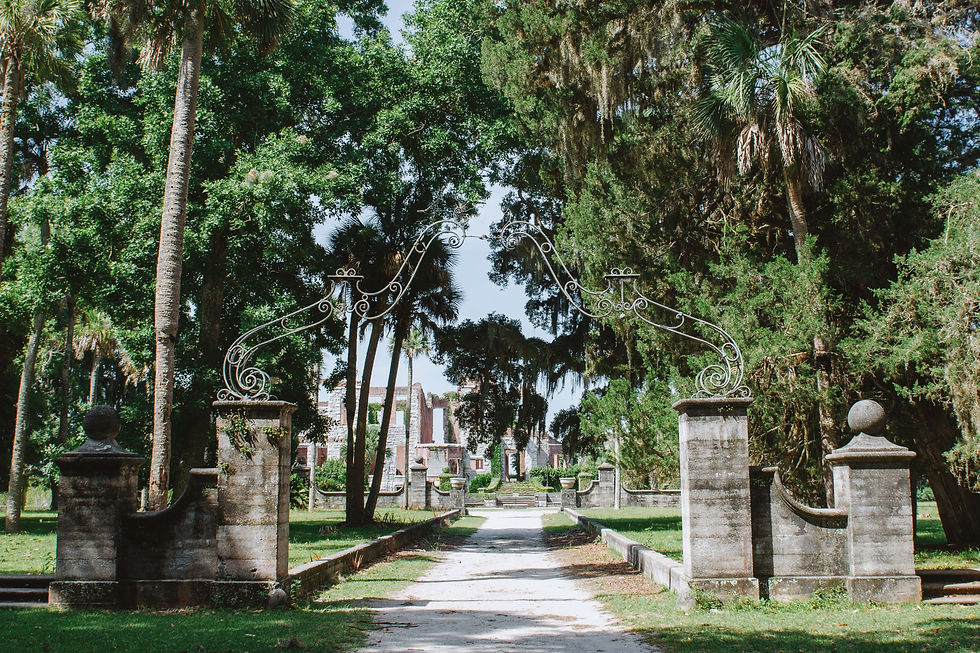
I picture turrets and verandas, glittering with glass and laughter, long before its broken walls come into view. A few more minutes along the sandy road and those imagined walls become real, as the front gate of Dungeness rises ahead of me at the end of the trees.

Ghosts at the Gate
As I stop to capture a photo of the front gate, I imagine the carriages and early motorcars that once rolled beneath its ironwork, bringing guests like the Astors, Vanderbilts, and Rockefellers to their winter escape on the edge of the sea, where afternoons were filled with tennis, golf, and long walks under these same trees.
I follow the same drive along the broad sweep of lawn they would have seen, only now the air smells of salt and sun‑warmed grass instead of cigar smoke and garden roses.
Then and Now: The Front Steps
At the front of the house, I frame the ruins in the same way those early photographs framed the castle‑like facade: palms still marching toward the entrance, chimneys still stabbing at the sky, but the windows are hollow, the rooms open to wind and birds.
Dungeness in its Gilded Age prime, the front steps and facade waiting to welcome arriving guests A century later, the front drive unchanged but the manor reduced to open walls and sky

From here, I step around the side of the house and head around back, following the curve of broken walls toward the lawn where women once drifted across terraces in pale dresses and men clustered in dark suits by the fountain. Now wild horses lower their heads to graze between cracked foundations, their hoofbeats a soft, steady metronome in a place that used to run on music and murmured conversation.

Before the Fire
What stands in ruin today was once one of the grandest private homes in America. In 1884, Thomas and Lucy Carnegie built this 59‑room mansion as their private winter retreat, a castle‑like escape from Pittsburgh’s smoke and steel.
The house rose, like something out of The Great Gatsby, on the site of an earlier Greene family estate. The Carnegies remade the south end of Cumberland into a full Gilded Age playground, complete with formal gardens, a fountain‑lined lawn, stables, and a small village of support buildings.

For decades, their family and guests arrived by boat each season to hunt, ride, and wander these same paths, until changing times, abandonment, and finally a devastating fire in 1959 left only the ruins that visitors walk among today.

A Quiet Lunch at the Edge of the Marsh
After wandering every corner of the Dungeness ruins, I find a weathered picnic table at the far edge of the back lawn, tucked under a canopy of live oaks where the grass fades into marsh grass and open sky. I set down my pack, pull out the lunch I carried over from the mainland, and let the silence settle around me.
By the time I finish my lunch there are no other visitors in sight, only the soft rustle of the marsh at my back and the sound of whatever birds have claimed this particular oak.

The Hands That Kept It Running
Rested and back on the path, I follow the trail north until the forest opens up into what was once the beating heart of the Carnegie estate: the service village. Built around 1900, this cluster of utilitarian buildings supported a staff of more than 200 workers who kept Dungeness running — blacksmiths, field hands, laundresses, woodworkers, and grooms.
The lower wing of the main barn alone held stalls for sixty horses, while grooms lived in the rooms above. At its peak, the Carnegie estate operated less like a winter retreat and more like a small, self-contained town.


Under the Oaks
Walking through the service village today, what strikes me most is not the historic structures but the trees. The live oaks here are extraordinary — massive, ancient, their long arms draped in curtains of Spanish moss that catch the afternoon light and sway in the slightest breeze. Every photograph I take here feels like I’m framing a painting that has been hanging in this forest for centuries.


Two Horses at the Wagon Shed
Near the old wagon shed, I come across two of the island’s feral horses, wandering then eventually grazing quietly in the dappled shade. Cumberland’s horses are descended from animals brought here for both work and pleasure, and in the 1920s a train-car load of Western mustangs was released to roam free. Now roughly 150 of their descendants wander the island’s forests, marshes, and meadows at will.


These two seem entirely indifferent to my presence. I watch them for a while, photograph them among the oaks and the moss, and then they simply turn and walk off down one of the narrow forest paths — paths that belong to them, not to any map. I watch them disappear into the trees and assume that is the last I will see of them.


I am wrong.
This Is Your Island
Further along the trail, where the path bends close to the edge of the marsh, I become suddenly and completely aware that I am not alone. Through a break in the brush, not more than a few feet away, two very large animals are staring directly at me. The horses. Their path and mine have crossed again, and neither of us heard the other coming.
We all stop dead in our tracks. I fumble for my camera, hands clumsy with surprise, trying to get the focus set before the moment disappears. I don’t manage it in time.
The only photos I have are blurred — a record of the shock more than the scene — and then one where the front horse has turned its head back to look at the horse behind it, as if conferring on what to do next.
What I remember most clearly is what happened in those few suspended seconds. The front horse stood perfectly still and looked at me with an expression I can only describe as patient. In that quiet, standing completely alone on this island with these two animals, I heard myself speak out loud: “No, this is your island. You go ahead.”
And the horse did. It simply turned forward and resumed walking, calm and unhurried, as though the matter had been settled. The second horse followed.
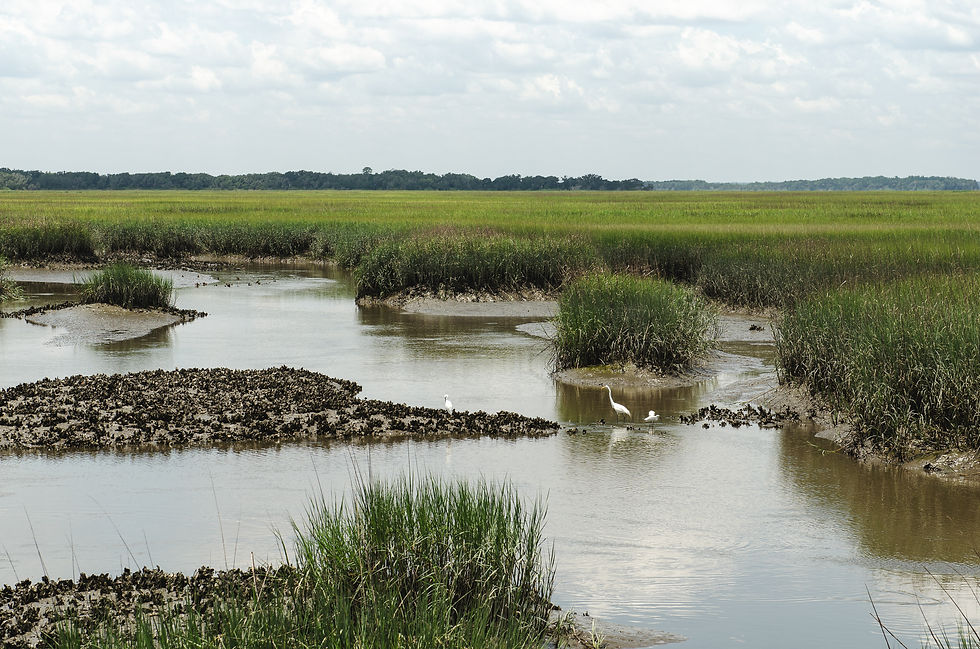
This time, our paths hadn’t just crossed — they had converged. Ahead of us both was a single wooden bridge over the marsh, the only way forward for either of us. They took it first, as I had insisted, moving single file across the weathered planks while I stood and watched. On the other side, the marsh grass opened up, and they dropped their heads and began to graze again, as if none of it had happened.
I stood there for a long moment after they were gone.
There are encounters that you know, while they are happening, that you will carry with you for a long time. This was one of them.


Where the Story Pauses
Ahead of me, the wooden boardwalk curves out over the marsh and into open sky. I can see the dunes from here, pale and wind-shaped at the edge of the trees, and beyond them, though I can’t see it yet, I know the ocean is waiting.
What I’ve covered in this post — the oak tunnel, the ruins, the service village, the horses at the marsh edge — is only a small corner of this island. Looking at the map below, the red circle marks where I’ve been. Everything outside it is still Cumberland Island, still wild, still waiting.
That will be Part Two.


Comments